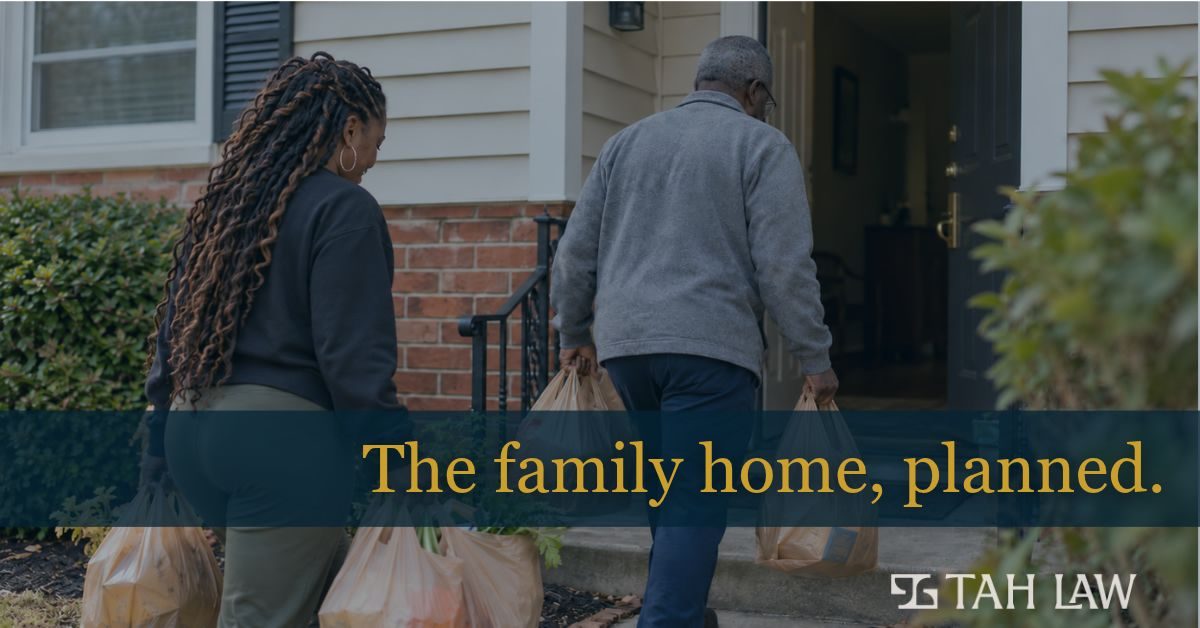
For many families, the house is the legacy. It’s where Sunday dinners happened and where the grandkids learned to ride their bikes. It’s the one thing everyone assumes will simply stay in the family.
It’s also, quite often, the asset with the least planning behind it. The mortgage gets paid off, the deed stays in one name, and the question of what happens next waits for another day.
Beginning October 1, 2026, Maryland homeowners have a new way to answer that question: the transfer-on-death deed, often called a TOD deed. The timing fits. October is Estate Planning Awareness Month, and this change is worth understanding before you act on it.
Why the Family Home Needs a Plan
When a home titled in your name alone passes at your death, it typically goes through probate, the court process for settling an estate. That’s true even with a will. Probate takes time, and it can leave the people you love managing filings and deadlines while they’re grieving. When ownership ends up split among several heirs with no direction, a home can also become harder to sell, refinance, or keep in the family over time. For families who worked for generations to own a home, that is not a small thing.
What a Transfer-on-Death Deed Does
A transfer-on-death deed lets you name one or more beneficiaries who will receive your Maryland real property at your death, without that property passing through probate.
Until then, nothing changes. You remain the owner. You can live in the home, sell it, refinance it, or revoke the deed if your wishes change. Your beneficiary has no ownership interest while you’re living and doesn’t need to be told about the deed or agree to it. The transfer happens only at your death.
What It Takes to Make One
Maryland’s new law sets out specific requirements:
- The deed must be signed, notarized, and recorded in the land records before your death. An unrecorded deed does nothing.
Recording a TOD deed on a primary or secondary residence is also exempt from recordation tax and county transfer tax.
The Details That Change the Outcome
This is where a simple document can produce a result nobody intended.
A will can’t override it. Under the new law, a will cannot revoke a recorded transfer-on-death deed, even a will signed years later. If your wishes change, the deed itself has to be revoked or replaced.
Naming more than one person comes with a default. If you name several beneficiaries and the deed doesn’t say otherwise, they take the home as joint tenants with rights of survivorship. In plain terms: leave the house to your three children, and if one of them later passes, that share goes to the surviving siblings, not to that child’s own children. If that isn’t what you want, the deed has to say so.
Plan for the unexpected. If a beneficiary dies before you, what happens to that share depends on technical rules and on how the deed is written. Naming an alternate beneficiary takes the guesswork out.
Debts travel with the house. The property passes subject to any mortgage, lien, or other claim attached to it at your death. Tax and creditor questions can still apply.
What It Doesn’t Do
A transfer-on-death deed answers one question: who gets the house. It doesn’t name someone to manage your finances or make medical decisions if you can’t. It doesn’t cover your bank accounts, personal property, or business. And it doesn’t name a guardian for minor children.
Avoiding probate on one asset is not the same as having a plan.
One Tool, One Job
A hammer is useful, but no one builds a house with only a hammer. A TOD deed works best alongside your will or trust, financial power of attorney, advance healthcare directive, and beneficiary designations — each doing its own job, all pointing in the same direction. When those pieces agree, your family inherits clarity instead of questions.
Before anything is recorded, three questions are worth answering, ideally out loud with the people you love:
- If I passed tomorrow, who should own this home?
Choosing the Right Tool
For some Maryland homeowners, a transfer-on-death deed will be the simplest way to keep the family home in the family. For others — people who already have a trust, blended families, or families with a beneficiary who receives public benefits — it may be unnecessary, or it may even undercut the rest of the plan.
At Tah Law, our role is to help you see how the pieces fit, then choose the ones that serve your family. If you already have a will or trust, an Estate Plan Review is a natural place to start. If you’re starting from scratch, we’ll begin with the home and build out from there.
Done well, the result is boring, and that’s exactly how you want it. The house stays where it belongs, the next generation inherits a home instead of a court file, and Sunday dinner keeps its address.
Legacy doesn’t protect itself. Planning does.
It starts with a conversation. Book yours online or call (240) 824-5295.
This article is for informational purposes only and does not constitute legal advice. Reading it does not create an attorney-client relationship. Every family’s situation is unique; please consult an attorney about your specific circumstances.